
How to read a perfume's barcode and batch code
Scanning the barcode or typing the batch code into a checker looks like a quick way to spot a fake. It isn't. Both codes are printed on the packaging, and anything printed can be copied.
The codes are still worth reading. Here is what each one really tells you, and how to use it before you buy.
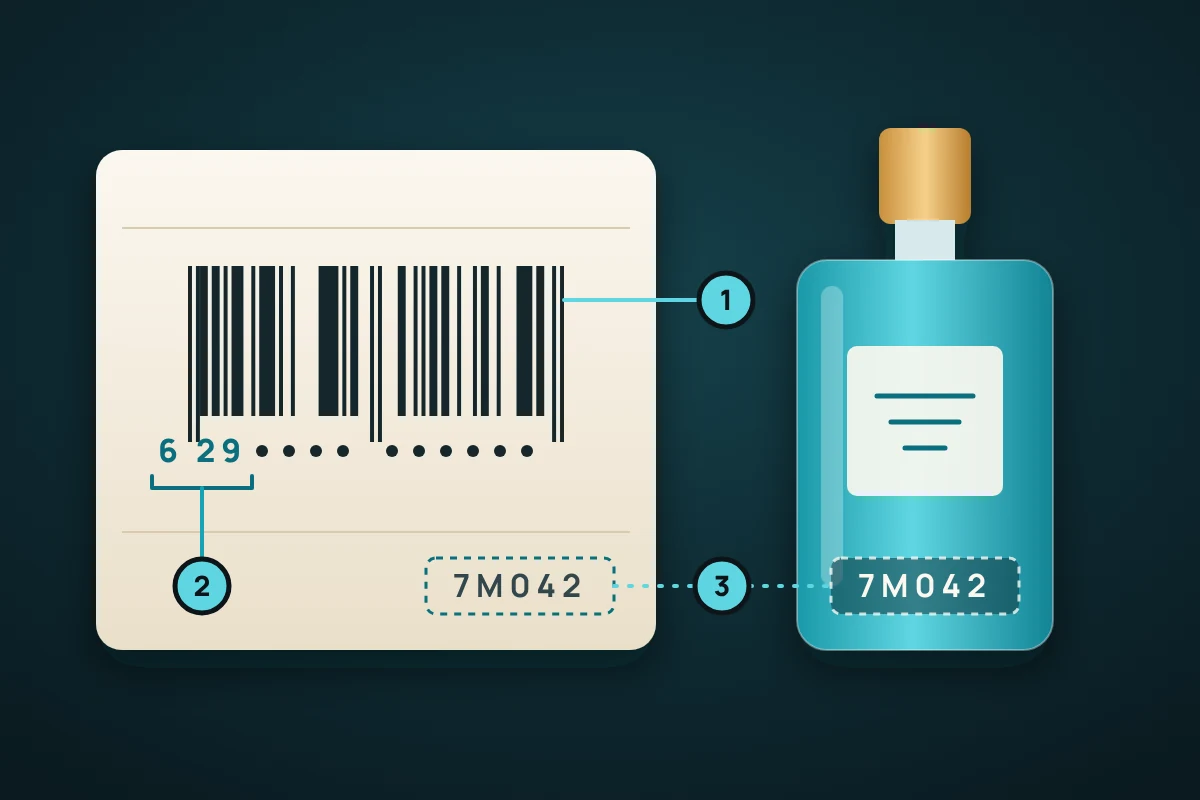
1. Barcode, batch code, serial number: three different things
These three codes get mixed up all the time. Each one does a different job.
- Barcode: the block of black lines with 12 or 13 digits underneath. It identifies the product: this fragrance, in this size. Every bottle of the same product carries the same barcode, and shops scan it at the till.
- Batch code (also called lot number): a short code of letters and digits, printed or engraved on the base of the box and on the bottle, on its base, on the back label or low on the glass. It identifies one production run: every bottle filled in that run shares it. Brands use it for quality control and for recalls.
- Serial number: a number that belongs to one single bottle. Most perfumes don't have one. A few brands give each bottle its own code, QR code or electronic tag, and explain on their own website how to check it.
When a seller or a website talks about a perfume's "serial number" or "code", they almost always mean the batch code.
2. What a barcode starting with 629 or 3 really means
The first three digits of a barcode are the GS1 prefix. GS1 is the organisation that manages barcode numbers worldwide through national offices, and the prefix shows which office issued the company's number. For example, 300 to 379 is GS1 France, 629 is GS1 Emirates (the UAE) and 800 to 839 is GS1 Italy.
The prefix doesn't show where the perfume was made (GS1 explains this here). A company registers its numbers where it is based, and it can produce anywhere in the world.
- A barcode starting with 3 doesn't prove that a perfume is original. Whoever copies a box copies the barcode with it.
- A barcode starting with 629 doesn't mean fake. Fragrance houses and distributors based in the UAE register their numbers here, so 629 is what you would expect on their products.
- The prefix often doesn't match the brand's home country. Many perfumes are produced under licence by another company, which uses its own barcode numbers.
Barcode scanner apps read the number and look it up in a product database. A match tells you that this number belongs to this product. It can't tell you whether the bottle in your hand is genuine, because a copied box carries the same number. No match proves nothing either: these databases have gaps.
GS1 has its own public lookup, Verified by GS1, which shows the company a barcode number is licensed to. That is useful to know, and it still says nothing about the single bottle.
3. What a batch code can tell you
From the batch code, the brand can tell when and where a bottle was filled. Each brand has its own format, formats change over the years, and brands rarely publish them.
For you as a buyer, the code is useful for three things:
- The age of the bottle. The code shows roughly when the bottle was made. That matters most with pre-owned and discounted bottles: an older perfume isn't bad by default, but you want to know its age and how it was stored. More on this in How to buy used perfume safely.
- The seller's story. "Bought last month" and a bottle made many years ago can both be true, but it is worth a question.
- Box and bottle. You can check whether the two belong together, as described in section 5.
What the code can't do is identify your bottle. Thousands of bottles share one batch code, and anyone can read it off a genuine box in a shop and print it on a copy.
4. Batch code checker sites: what the result means and what it doesn't
Batch code checker websites and apps are not run by the brands and have no access to their records. They know the code patterns that many brands use, and they calculate a production date from the code you type in.
- You get a date. The code fits a pattern this brand uses. For a genuine bottle that is a good estimate of its age. A copy with a copied code gets exactly the same result.
- "Not found", or a strange date. The brand may have changed its format, the site may not cover the brand, or one character was misread: 0 and O, 1 and I, 5 and S look alike in small print. It is a reason to look closer, not proof of a fake.
- Two possible years. Some formats repeat after a number of years, so one code can stand for two different dates.
Use a checker to estimate the age of a bottle. Don't use it as an authenticity test.
What a bottle's age means for the perfume inside is covered in Does perfume expire?
5. The code on the box and the bottle should match
- On most genuine products the batch code on the base of the box is the same as the one on the bottle.
- Buying from a private seller? Ask for a clear photo of the base of the box and one of the code on the bottle, then compare them character by character. On the bottle the code is often small, engraved or printed in pale ink, so ask for a photo in good light.
- Gift sets: the outer box of a set can carry its own code, different from the one on the bottle inside.
- Testers and unboxed bottles: there is nothing to compare with, so the code on the bottle is all you have.
- Two different codes on one boxed bottle are a strong reason to ask questions. Often it means that the box belongs to another bottle.
6. Missing, scratched or cut-out codes
Sometimes the batch code has been scratched off the bottle, covered with a sticker or cut out of the box.
- Codes are sometimes removed so that a bottle can't be traced back through the supply chain. That alone doesn't prove that the perfume is a copy.
- But you lose two checks at once: you can't compare box and bottle, and you can't estimate the age of the bottle. And you can't know why the code was removed.
- On an old or much-used bottle, a printed code can simply wear off the base. Look for traces of it, and check the box.
- Either way, ask the seller. A seller who refuses to show the codes at all gives you a good reason to walk away.
7. Codes are one check among many
Read the codes, then keep going. The seller, the price, the box, the print, the bottle and the sprayer tell you more together than any code can. The full checklist is in How to tell if a perfume is original.
Pre-owned bottles from strangers are where these checks are hardest. That is why we built PERFUMI's Fake Check: the seller sends the bottle to PERFUMI, our team inspects it by hand, and PERFUMI keeps it until it ships to the buyer. Bottles that pass carry the Fake Check seal and the highest trust level, and they are shown first in the Souk. The seal shows PERFUMI's own check, not a brand certificate. Fake Check is an optional, paid inspection service for original bottles in the UAE.
Every listing in the PERFUMI Souk also shows a trust level built from real evidence, from a confirmed phone number up to a passed Fake Check. Trust levels help you decide; they are not a guarantee.
Frequently asked questions
Can I scan a barcode to check if a perfume is original?
No. A scan shows which product the number belongs to. A copied box carries the same barcode, so a genuine bottle and a copy get the same result.
Does a 629 barcode mean the perfume is fake?
No. 629 is the prefix of GS1 Emirates. It shows that the company's barcode number was registered in the UAE, not where the perfume was made and not whether it is genuine.
Does a valid batch code prove authenticity?
No. Every bottle of one production run shares the same batch code, and it is easy to copy from a genuine box. A checker result tells you the likely production date, nothing more.
Where is the batch code on a perfume?
Usually on the base of the box and on the bottle: on its base, on the back label or engraved low on the glass. It is a short code of letters and digits, separate from the barcode.
Do perfumes have a serial number?
Most don't. What people call the serial number is usually the batch code, which a whole production run shares. A few brands give each bottle its own code and explain on their own website how to check it.
More guides: Perfume decants: what they are and how to buy them, Selling used perfume in the UAE, How to decant perfume, Tester perfumes and whether they are original, What niche perfume means, Perfume dupes and similar scents, Does perfume expire?, Eau de parfum vs eau de toilette, Oud, bakhoor and attar, Perfume notes explained, Where to buy original perfume in Dubai and How to make perfume last longer.
Get PERFUMI
PERFUMI is now on Google Play in the UAE. The iPhone app is coming soon: leave your email and we'll tell you the moment it's on the App Store.