
Perfume notes explained: top, heart and base notes
A perfume doesn't smell the same after an hour as it did in the first minute. Notes are the words for that change: what you smell first, what stays through the day, and what is still on your scarf the next morning.
This guide explains what perfume notes are, how top, heart and base notes follow each other, what accords, fragrance families and the fragrance wheel are, and how to read a note list before you buy.
1. What perfume notes are
A note is a single smell you can pick out in a perfume: lemon, rose, vanilla, cedar. Perfume houses publish a list of notes for each perfume to describe how it smells.
The word comes from music, and the comparison helps. One note alone is a sound. Several together make a chord, and a perfume is the whole piece, changing as it plays.
2. Top, heart and base notes
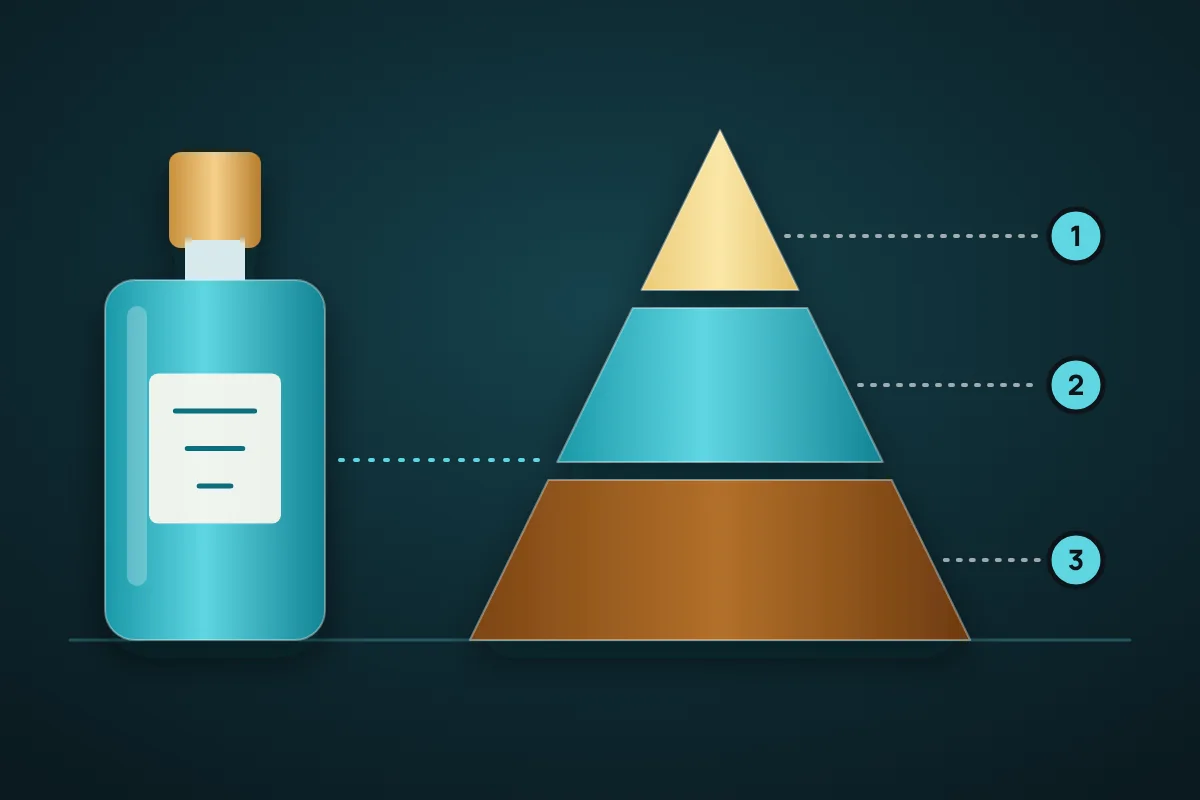
The materials in a perfume leave the skin at different speeds. Light ones rise quickly and are gone soon. Heavy ones stay. That is why perfume is described in three layers, often drawn as a pyramid:
- Top notes, also called head notes or opening notes: what you smell in the first minutes. Usually fresh and bright, such as citrus, herbs and light fruit. They fade within about a quarter of an hour.
- Heart notes, also called middle notes: the body of the perfume. They appear as the top fades and last for a few hours. Flowers, spices and fuller fruits are typical.
- Base notes: the foundation. Woods, resins, musk, vanilla, amber and oud show after half an hour or so and can stay for many hours on skin, and longer on fabric.
The last stage, when only the base is left, is called the dry down. It is the part of a perfume you live with the longest.
The pyramid is a simple picture, not a timetable. The layers overlap, and some perfumes are built to smell almost the same from start to finish. Those are called linear.
3. Notes, accords and ingredients
These three words are often used as if they meant the same thing. They don't:
- An ingredient is a material that is really in the bottle.
- A note is a smell you notice. It may come from one material or from a mix of many. A "leather" or "sea breeze" note comes from no single ingredient.
- An accord is a blend of several notes that smells like one new thing. Amber is the best-known example: a warm, sweet mix of resins and vanilla.
So a note list is the house's description of what you will smell. It is not a recipe, and two perfumes with the same list can smell clearly different.
4. Fragrance families and the fragrance wheel
Perfumes are sorted into families by their overall character. The names vary a little from one source to another, but four large groups are common:
- Fresh: citrus, green, watery and aromatic scents. Clean and light.
- Floral: built around flowers, from a single rose to a whole bouquet.
- Amber, in older texts called oriental: warm, sweet and spicy, with resins, vanilla and incense.
- Woody: sandalwood, cedar, vetiver, patchouli and oud. Dry or creamy, often warm.
You will also meet a few names from perfume tradition:
- Fougère: lavender, moss and a sweet, hay-like base. The classic barbershop style.
- Chypre: a bright citrus opening over a dark, mossy base.
- Gourmand: notes that smell edible, such as vanilla, caramel, coffee and chocolate.
- Leather: smoky, dry and animal.
The fragrance wheel arranges these families in a circle, so that neighbours are similar and opposites are far apart. It is useful in one way above all: if you like a perfume, the families next to it on the wheel are the best place to look for your next one.
5. Common notes and how they smell
- Bergamot and lemon: sharp, juicy and bright. Classic top notes.
- Lavender: clean, herbal and a little sweet.
- Rose and jasmine: the two great flowers of perfume. Rose is fresh and rich, jasmine heavier and sweeter.
- Orange blossom: soft, sunny and slightly soapy.
- Vanilla and tonka bean: sweet, creamy and warm.
- Sandalwood and cedar: sandalwood is creamy and soft, cedar dry like pencil shavings.
- Vetiver and patchouli: earthy. Vetiver is green and smoky, patchouli dark and damp.
- Musk: soft, clean and skin-like. It makes other notes last.
- Oud, saffron and incense: deep, warm and resinous. They are at the heart of Arabic perfume: see Oud, bakhoor and attar.
6. How to read a note list
- Start at the bottom. The base notes tell you what you will smell for most of the day. The top notes are gone before you leave the house.
- Look for the notes you already know. If three perfumes you love all have vanilla in the base, that is your clue.
- Don't count on one note. A rose perfume can be fresh and green or dark and jammy. The notes around it decide.
- Check the version. The eau de toilette and the eau de parfum of one perfume often have different notes. See same name, different smell.
- Treat it as a hint. A list tells you whether a perfume is worth trying. Only your nose tells you whether you like it.
Shared notes are also the simplest way to find a perfume that smells like one you know. Perfume dupes and similar scents shows how.
7. How to test a perfume
- Spray on a paper strip first. If you like it, spray on your skin.
- Don't decide in the first minute. That is only the top. Wait at least half an hour for the heart.
- Smell it again after a few hours. If you still like the dry down, the perfume suits you.
- Test no more than three at a time. After that, the nose stops telling them apart.
- Skin, weather and temperature change a perfume. Try it on your own skin, in the conditions you will wear it in.
A small decant or sample lets you wear a perfume for a few days before you buy a full bottle. More in Perfume decants: what they are and how to buy them.
8. Notes when you buy or sell
- An older bottle can lose its top notes. The fresh opening fades first with age and heat, while the heart and base often stay intact. How to know if a perfume has expired explains how to judge that.
- If you buy: ask the seller how the opening smells now, not only how the perfume is described.
- If you sell: name the main notes and the family in your listing, and say so if the opening has changed. It helps the right buyer find the bottle.
- A wrong smell is a warning sign. If a bottle smells nothing like its notes from the first spray to the dry down, check it with care. See How to tell if a perfume is original.
In PERFUMI's Souk you can buy, sell, trade or request bottles, samples and decants. Every listing shows a trust level built from real evidence, such as a confirmed phone number or buyer reviews. Trust levels help you decide; they are not a guarantee.
Frequently asked questions
What are top notes in perfume?
Top notes are what you smell in the first minutes after spraying. They are light and fresh, typically citrus, herbs or light fruit, and they fade within about a quarter of an hour.
What are heart notes?
Heart notes, also called middle notes, are the body of a perfume. They appear as the top notes fade and last for a few hours. Flowers and spices are typical.
What are base notes?
Base notes are the heaviest materials in a perfume, such as woods, resins, musk and vanilla. They appear last and stay longest, often for many hours.
What does dry down mean?
The dry down is the last stage of a perfume, when the top and heart have faded and mostly the base is left. It is how the perfume smells for most of the time you wear it.
What are the main fragrance families?
Most systems use four large groups: fresh, floral, amber and woody. Fougère, chypre, gourmand and leather are well-known styles within or between them.
Why does the same perfume smell different on me?
Skin is warmer or cooler, drier or oilier from one person to the next, and that changes how fast the notes rise. Weather and what else is on your skin matter as well. That is why testing on your own skin counts.
Is a note the same as an ingredient?
No. An ingredient is a material in the bottle. A note is a smell you notice, and it can come from a mix of many materials.
More guides: What is niche perfume?, Perfume dupes and similar scents and Does perfume expire?
Get PERFUMI
PERFUMI is now on Google Play in the UAE. The iPhone app is coming soon: leave your email and we'll tell you the moment it's on the App Store.